I find it interesting that people have taken bits of what I've written and turned them into quotations, putting them in books and posting them around the Internet. Unfortunately they're becoming a bit harder to find now that the search engines are focusing more on commercial sites, while ignoring personal sites, but I still come across them.
It's quite an honor to be quoted next to many of the world's greatest literary figures. I never expected it.
Most of the quotations are from my earlier books, since it takes time for readers to find them. Once someone posts them, they slowly begin to spread, so I expect some will eventually appear from my later books. Often I'm surprised at what they select. Sometimes when I tell people that I'm quoted around the world, they don't understand what I mean, so here are just a few examples.
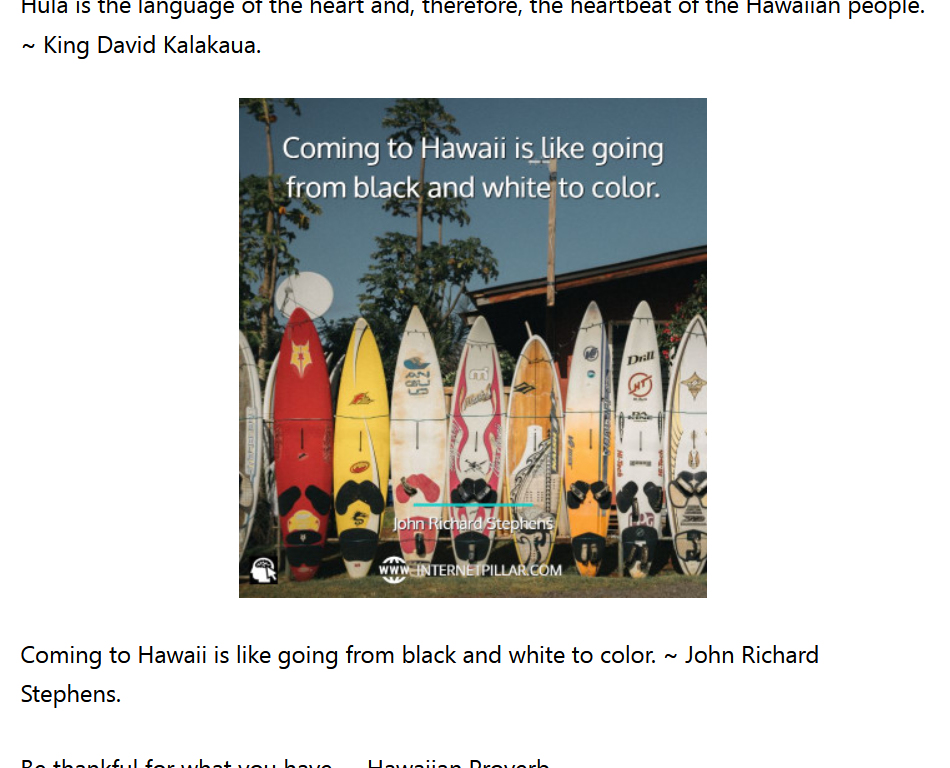
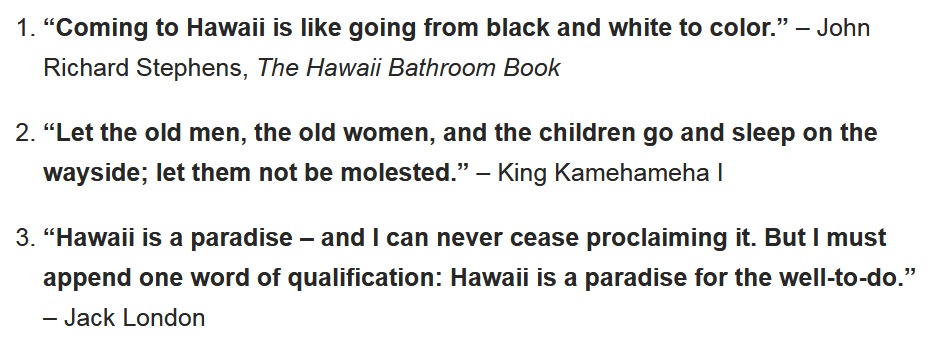
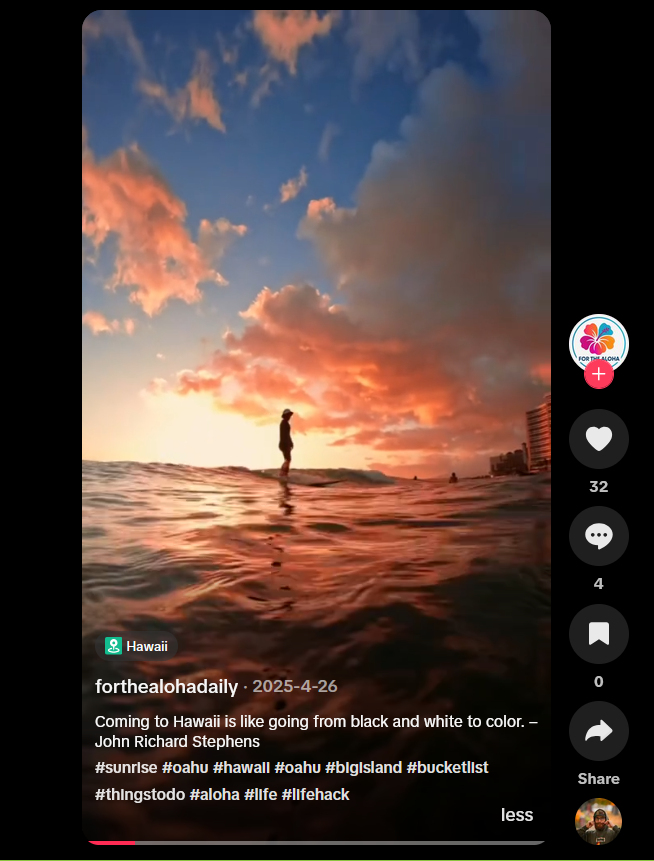
Coming to Hawai'i is like going from black and white to color.
—"The Literary Guidebook to Hawaii", "The Hawaii Bathroom Book", and "Mark Twain's Hawaii"

The only good thing about leaving Hawaii is that you really appreciate it when you return.
—from "The Hawaii Bathroom Book"
Hawai'i is the only place in the fifty states where you can see the stars of the entire northern and southern hemispheres. Here, stars that can't be seen from the mainland are visible, along with stars that aren't visible from Australia.
—from "The Hawai'i Bathroom Book"
Hawaii is a paradise that seems to be a little closer to heaven than any other place on earth.
—source unknown. I've written three books on Hawai'i, but can't find this in any of them. I'm not sure whether I should take credit for it.

Hawai'i is the most isolated population center on Earth, with the nearest points being between Hilo on the Big Island and San Francisco in CA 2,315 miles away.
—from "The Hawai'i Bathroom Book"
Setting aside embassies, consulates, and military bases, Rose Atoll of American Samoa is the southernmost point of U.S. controlled territory. Guam, Puerto Rico, the U.S. Virgin Islands, and half a dozen other islands are all further south than Ka Lae [on Hawaii's Big Island]. While Ka Lae is not the southernmost point of the United States, it is the southernmost point of the fifty states.
—from "The Hawaii Bathroom Book"
Did you know? Duke Kahanamoku competed in four Olympics from 1912 to 1932 setting three world-records, while winning three gold medals, two silver, and one bronze.
—from "The Hawaii Bathroom Book"
Traditional (Hawaiian Saying): A road goes down, up and level. In other words, life is like a road.
—from "The Hawaii Bathroom Book"

Traditional Saying (Hawaiian): Only when the water gourd isn't full do you hear it gurgling. (Those who are ignorant have an awful lot to say.
—from "The Hawaii Bathroom Book"
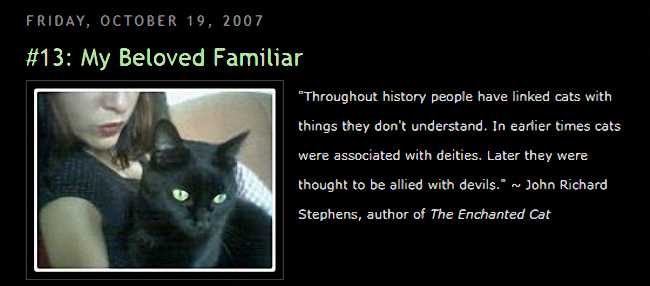
Throughout history people have linked cats with things they don't understand. In earlier times cats were associated with deities. Later they were thought to be allied with devils.
—from "The Enchanted Cat"
Since our housecat no longer has to hunt, she may spend hours dreaming and philosophizing. Perhaps when she sleeps, she dreams of the wild.
—from "The Enchanted Cat"

People have a hard time achieving happiness in their lives. They tend to get wrapped up in their own little world. People get confused because they do not know what they need or want, and then depression sets in. Dogs do not have this problem. They know exactly what makes them happy-doing something for someone. They will do everything they can think of to please their human companions, and any signs that they have been successful make them very happy.
—from "The Dog Lover's Literary Companion"
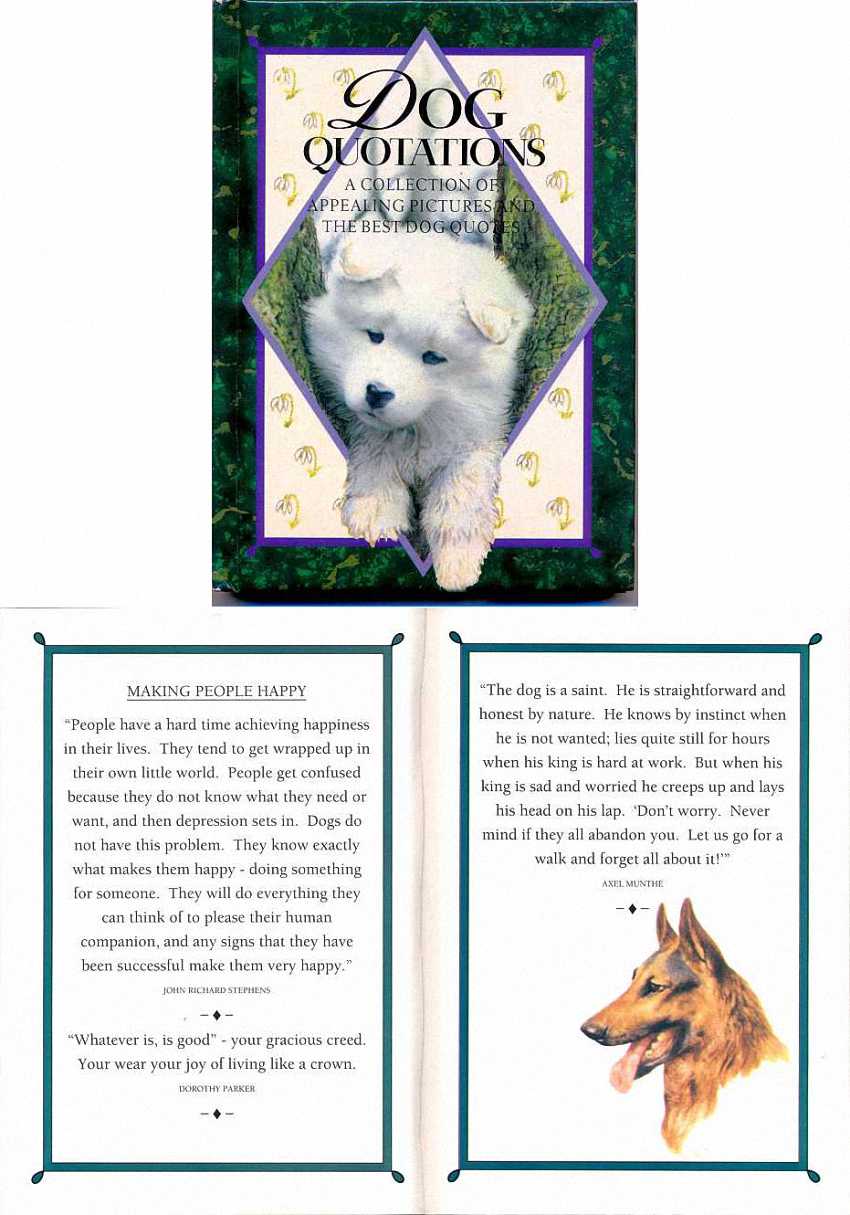
In the book Dog Quotations.
(In Hungarian)
Az emberek többségének komoly gondot okoz a boldogság elérése. Hajlamosak bezárkózni a maguk kis világába, és könnyen megkeverednek, mert nem tudják, valójában mire vágynak és mit akarnak, ez pedig sokszor depresszióhoz vezet. A kutyáknak nincsenek ilyen problémáik. Pontosan tudják, mi teszi ?ket boldoggá - tenni valamit valakiért. Bármire képesek, amkr?l úgy gondolják, örömet okozhat emberi társuknak, és fáradozásaik sikerének legparányibb jele is boldoggá teszi ?ket.
(In Norwegian)
Folk har vanskelig for å finne lykken i livet. De går seg lett vill i sin egen lille verden. Folk blir forvirret fordi de ikke vet hva de trenger eller ønsker seg. - og så blir de deprimerte. Hunder har ikke dette problemet. De vet nøyaktig hvordan de skal bli lykkelige - ved å gjøre noe for andre. De vil gjøre alt som faller dem inn for å glede sin følgesvenn blandt menneskene, og ethvert tegn på at de lykkes gjør dem lykksalige.
(In Italian)
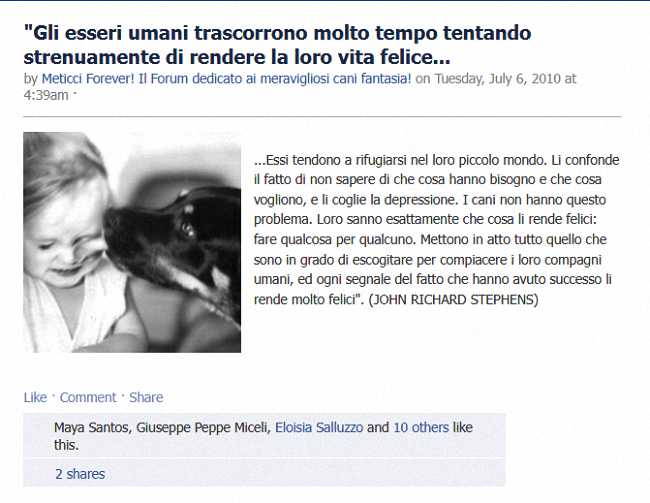
Gli esseri umani trascorrono molto tempo tentando strenuamente di rendere la loro vita felice. Essi tendono a rifugiarsi nel loro piccolo mondo. Li confonde il fatto di non sapere di che cosa hanno bisogno e che cosa vogliono, e li coglie la depressione. I cani non hanno questo problema. Loro sanno esattamente che cosa li rende felici: fare qualcosa per qualcuno. Mettono in atto tutto quello che sono in grado di escogitare per compiacere i loro compagni umani, ed ogni segnale del fatto che hanno avuto successo li rende molto felici.


I was even quoted at the conclusion of a scientific paper.
Maybe there are some areas where, when we are compared to dogs, we come up short. Being called a "dog" might not be such a bad thing after all.
—from The Dog Lover's Literary Companion
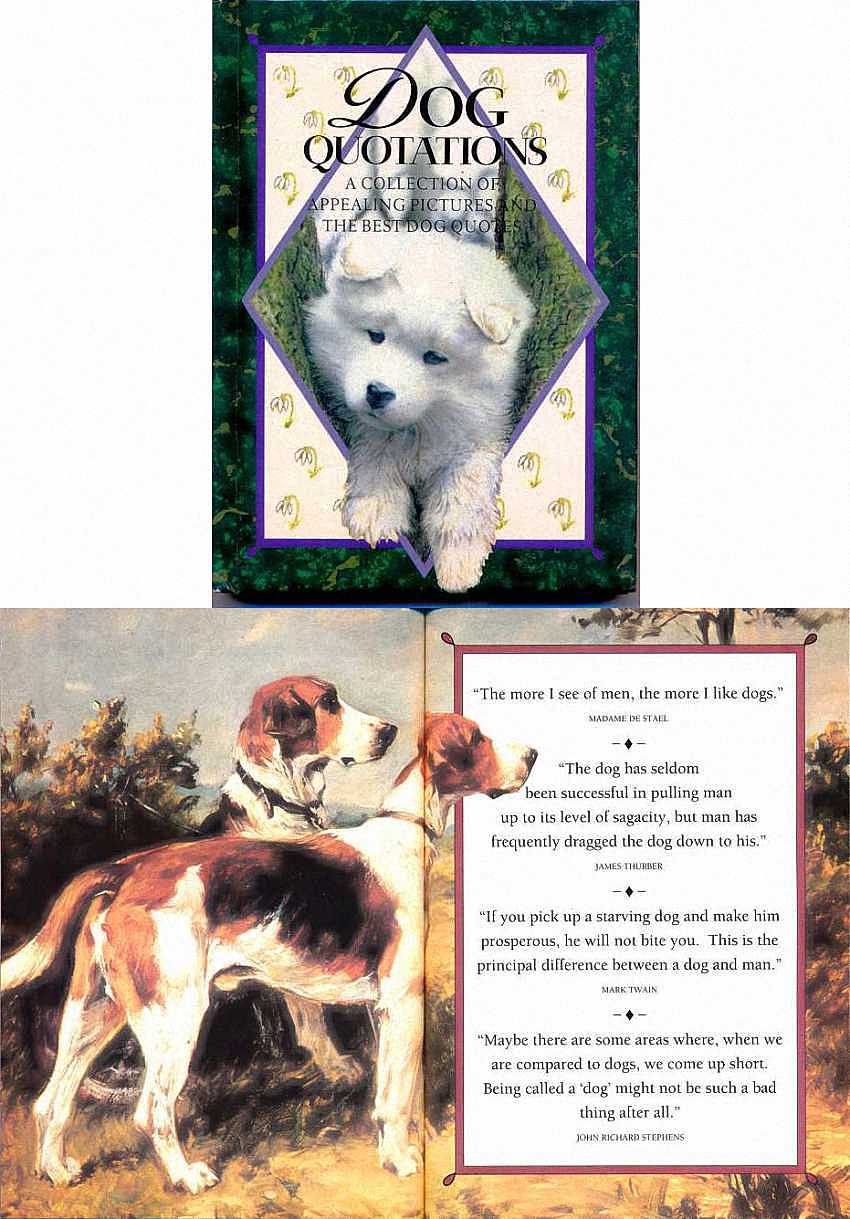
In the book Dog Quotations.
(In Danish.)
Måske er der visse områder, hvor vi når vi sammenlignet med hunde, kommer til kort. Så det at blive kaldt en køter /tæve er måske ikke så slemt endda.

(In Italian.)
Forse ci sono dei paesi, nei quali, venendo paragonati a un cane, si acquista in breve maggiore importanza, salendo nella scala sociale. Essere chiamati "cani" potrebbe rivelarsi una cosa poi non così brutta.

(In Spanish.)
Tal vez haya algunos terrenos en donde, comparados con un perro, no demos la talla. Quizá no sea, al fin y al cabo, un insulto que te llamen "perro".
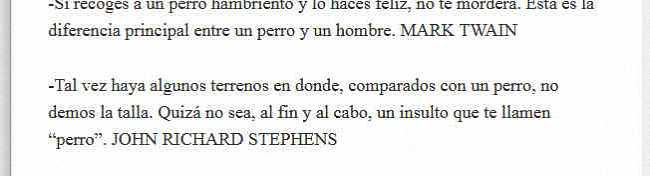
And Google Translate added a different spin on it.

Puppies are nature's remedy for feeling unloved...plus numerous other ailments of life.
—Richard Allan Palm, from "The Dog Lover's Literary Companion"
I am Richard Allan Palm. I didn't want to quote myself in my own book, so I used my birth name. At the age of three months, my name changed when I was adopted.
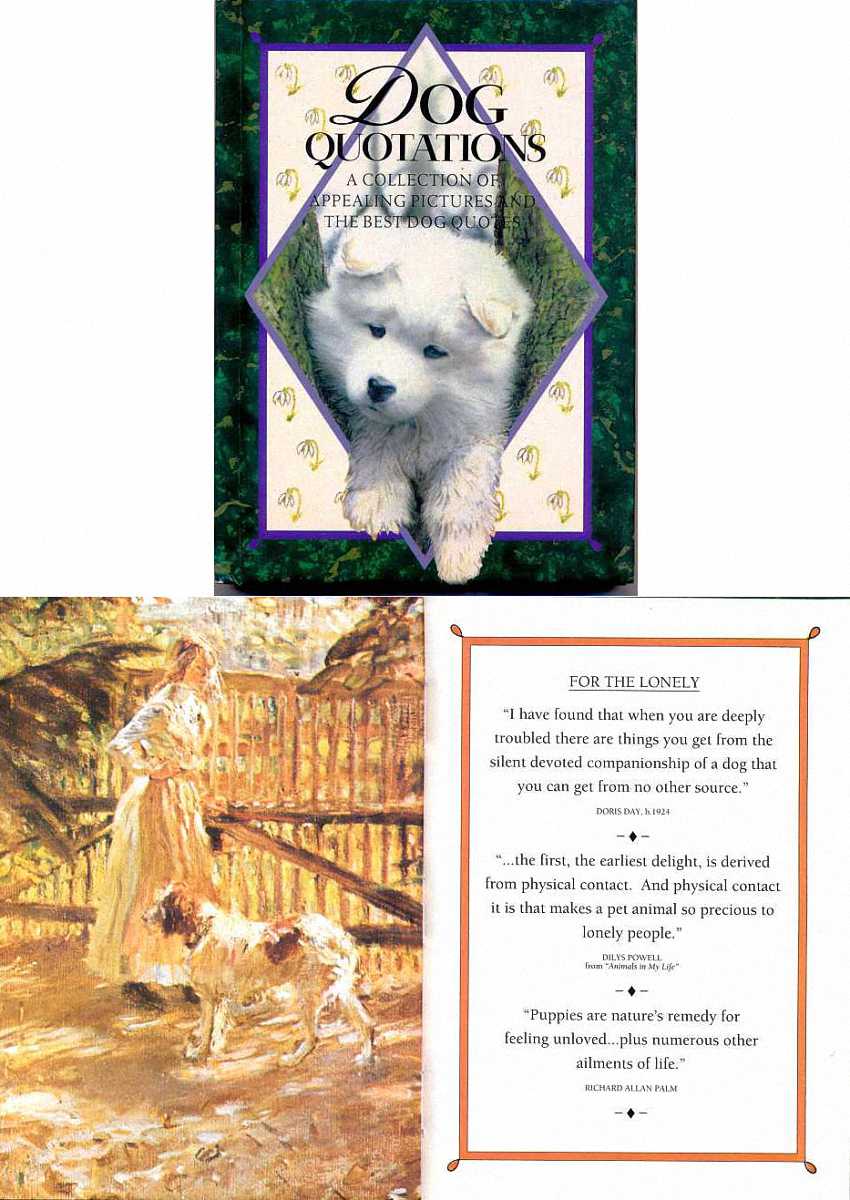
In the book Dog Quotations.
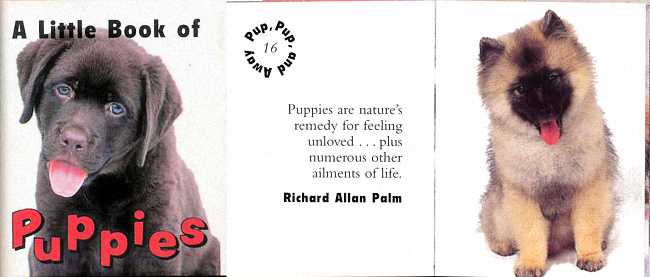
In the book A Little Book of Puppies.
(In Italian.)
I cuccioli sono il rimedio naturale alla sensazione di non essere amati... e per numerosi altri dolori della vita.

(In German.)
Welpen sind ein natürliches Heilmittel für alle, die sich nicht geliebt fühlen, sowie für viele andere Krankheiten des Lebens.

(In Hungarian.)
A kiskutya a természet kínálta gyógyír a szeretet hiányára...és az élet sok egyéb bajára is.
(In Danish.)
Hundehvalpe er naturens modgift imod ensomhed...plus et flertal af livets andre små glæder.

<
(In Swedish.)
Valpar är det naturliga botemedlet mot att känna sig oälskad...liksom mot en mängd andra krämpor i livet.

The hunting dogs of the Nyanga people of Africa have rights equal with those of the hunters and above those of the women and children. In fact, a hunter will do everything he can to protect his dog from even minor injuries, or discomforts, often at the expense of his own welfare. So, in some ways, he is even treated better than the hunter himself. Much of this special treatment came about because of the valuable, unconditional friendship dogs offer.
—from "The Dog Lover's Literary Companion"
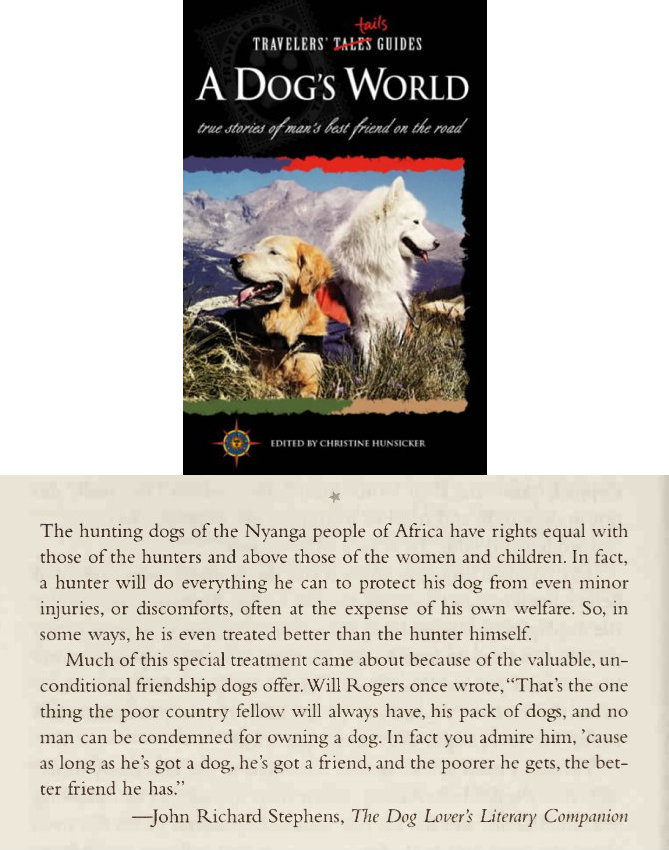
In the book A Dog's World.
Excavators digging through the volcanic ash that buried the ruins of Pompeii in a.d. 79 discovered a dog lying across a child. The dog, whose name was Delta, wore a collar that told how he had saved the life of his owner, Severinus, three times.
—from "The Dog Lover's Literary Companion"
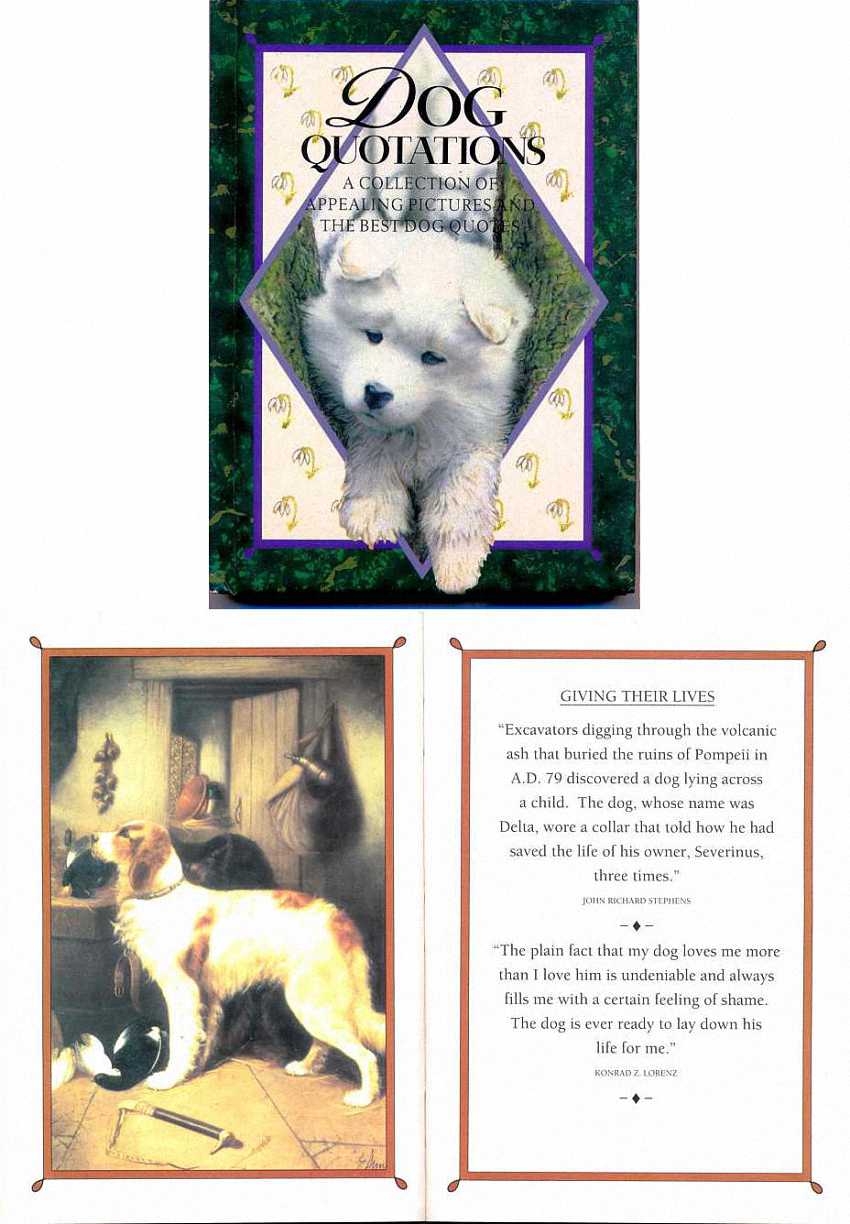
In the book Dog Quotations.

(In Italian)
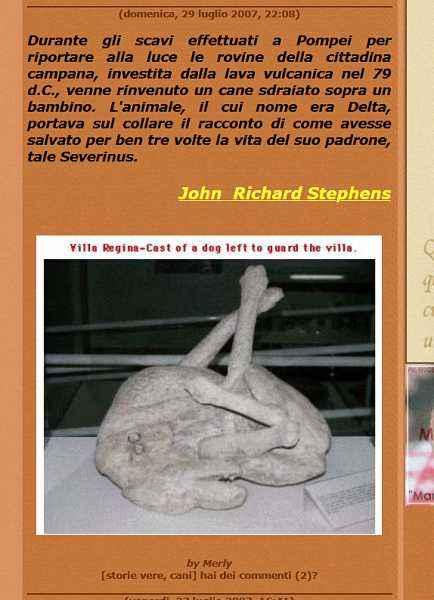
Durante gli scavi effettuati a Pompei per riportare alla luce le rovine della cittadina campana, investita dalla lava vulcanica nel 79 d.C., venne rinvenuto un cane sdraiato sopra un bambino. L'animale, il cui nome era Delta, portava sul collare il racconto di come avesse salvato per ben tre volte la vita del suo padrone, tale Severinus.

(In German.)
Bei Ausgrabungen in den Ruinen von Pompeji wurde in der vulkanischen Asche ein Hund gefunden, der über einem Kind lag. Der Hund, dessen Name Delta war, rug ein Halsband auf dem zu lesen war, dass er seinem Besitzer Severinus dreimal das Leben gerettet hatte...
(In Swedish.)
Vid utgrävningar i den vulkaniska aska som år 79 e.Kr. begravde ruinerna av Pompeji upptäcktes en hund som låg tvärs över en flicka. Hunden, vars namn var Delta, bar ett halsband som berättade hur den hade räddat livet på sin ägare, Severinus, tre gånger.
Macadamia nuts can be fatal to dogs, sometimes causing seizures and kidney failure.
—from "The Hawaii Bathroom Book"

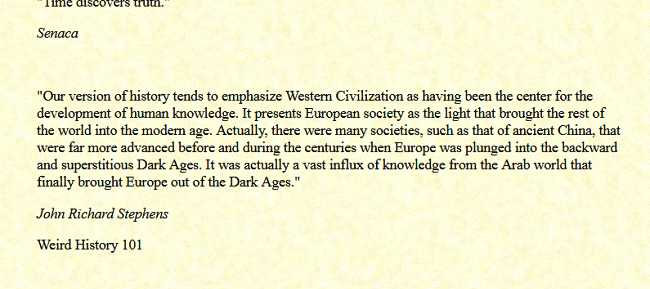
Our version of history tends to emphasize Western Civilization as having been the center for the development of human knowledge. It presents European society as the light that brought the rest of the world into the modern age. Actually, there were many societies, such as that of ancient China, that were far more advanced before and during the centuries when Europe was plunged into the backward and superstitious Dark Ages. It was actually a vast influx of knowledge from the Arab world that finally brought Europe out of the Dark Ages.
—from "Weird History 101"
History repeats itself because people refuse to learn from the mistakes of others.
—You can quote me on this
(This is the original unedited quotation:) To its practitioners, voodoo is much more than a religion—it is their entire world view. It influences all their actions and beliefs. Ethnobotanist Wade Davis, who wrote "The Serpent and the Rainbow"— among other books on voodoo and zombies—pointed out, "It's not just a body of religious ideas, but a notion of how children should be raised, a notion of what education means, an awareness of politics." They see everything in the world as voodoo, along with everything they receive in life and everything that happens to them. Voodoo controls pleasure and pain. It controls the weather, politics and whether something good or bad will happen to them on a given day. It is everywhere, including in other religions; thus voodooists have no problem also belonging to Christian churches. Voodoo is all about power and they will use anything they believe is powerful, including quotations from the Bible and images of the Devil. Voodoo is also the invisible world that permeates the physical one and directly influences it. On occasion the veil opens and direct contact with the spirits is made.
![[This is the unedited quotation:]](images/quotations/5Voodoo01.jpg)
Here are a few of my overlooked quotations:
Bad art is better than no art.
—Please quote me on this one. I often think that even the MonkeyChrist drew attention to art.
No one will ever hate you more than an ex-lover.
No matter where you go, there you are.
I believe that our Heavenly Father was so disappointed in man that he created the monkey.
—my variation of a quotation by Mark Twain, "What is Man? Man is a noisome bacillus whom Our Heavenly Father created because he was disappointed in the monkey.".
I'm included on a page of authors whose work is similar to that of Erica Jong.
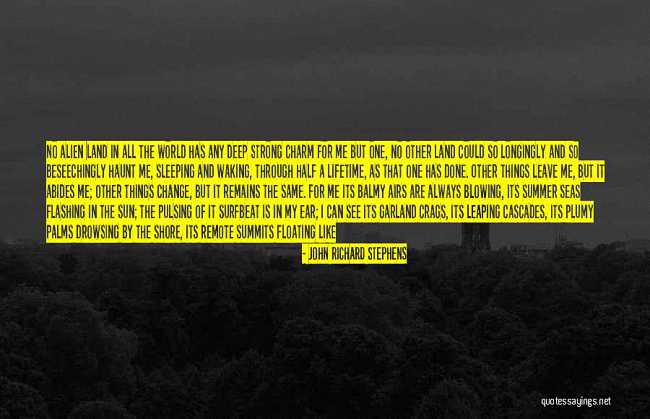
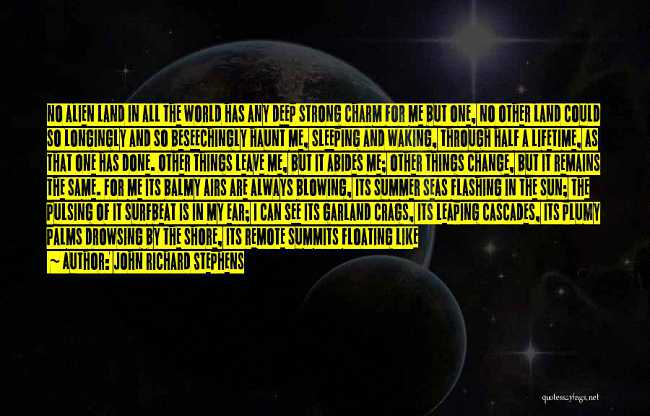
No alien land in all the world has any deep strong charm for me but one, no other land could so longingly and so beseechingly haunt me, sleeping and waking, through half a lifetime, as that one has done. Other things leave me, but it abides me; other things change, but it remains the same. For me its balmy airs are always blowing, its summer seas flashing in the sun; the pulsing of it surfbeat is in my ear; I can see its garland crags, its leaping cascades, its plumy palms drowsing by the shore, its remote summits floating like islands above the cloud wrack; I can feel the woodland solitudes, I can hear the splash of its brooks; in my nostrils still lives the breath of flowers that perished twenty years ago.
—This is not me. It's actually Mark Twain. People sometimes confuse my writings with Mark Twain's and vice versa. It didn't help that the publisher of Mark Twain's Hawaii didn't do more to distinguish what I wrote from what parts Twain wrote. On reading the book, even I get confused as to which is me and what is Twain's. I wanted to use different fonts, but they refused. I then had to argue with them to make my parts slightly smaller than Twain's. They agreed, but what they did is almost imperceptible. Still, that's not the cause of the confusion here, as this was clearly labeled as Twain's. I guess I should be honored that some of my quotations are attributed to Twain and some of Twain's are attributed to me.
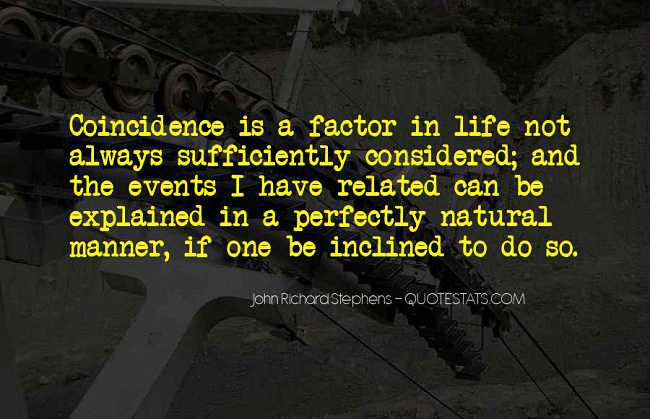
Coincidence is a factor in life not always sufficiently considered; and the events I have related can be explained in a perfectly natural manner, if one be inclined to do so.
—This is from my book "Into the Mummy's Tomb", but it's not me. It's actually expert Egyptologist Arthur Weigall. It does sound like me though.